How to Set Up a Cook Islands Trust
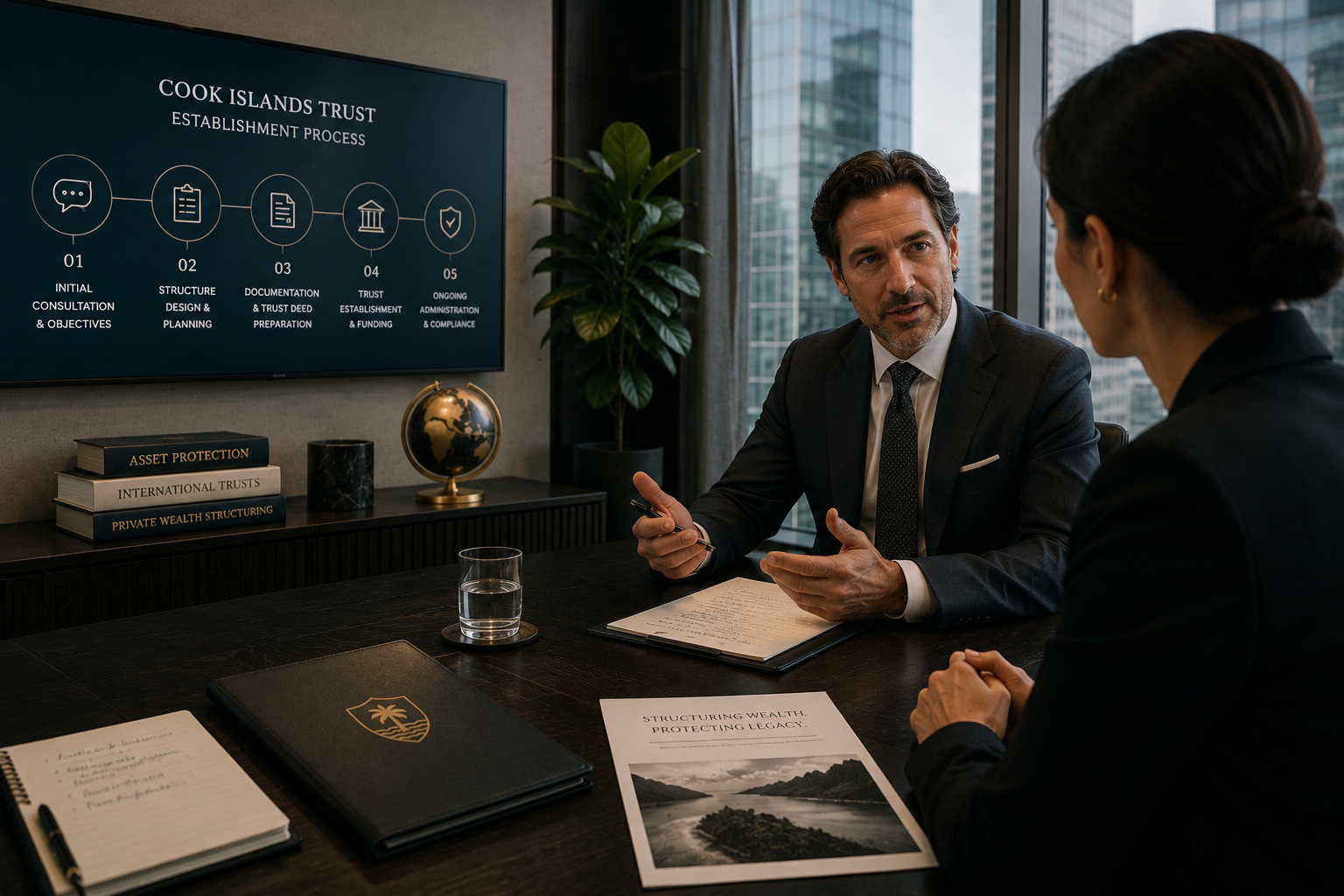
Establishing a Cook Islands trust begins with strategy, structure, and experienced guidance tailored to long-term wealth preservation goals.
A Practical Guide for Individuals Thinking Beyond Traditional Asset Protection
For many people, the idea of establishing an offshore trust feels like a major leap.
Not because the concept itself is difficult to understand, but because it represents a shift in mindset. Most individuals spend their lives building wealth inside a single legal and financial system. A Cook Islands trust introduces the idea that protecting wealth may sometimes require thinking beyond that system altogether.
That realization often comes after years of business growth, increased public visibility, rising litigation exposure, or simply watching how quickly financial conditions can change globally.
In practice, setting up a Cook Islands trust is less mysterious than people expect. The process is structured, highly regulated, and typically coordinated by experienced legal and financial professionals.
Still, there are important decisions involved, and understanding how the process works can help individuals approach it with greater clarity.
The First Step Is Usually Strategic, Not Legal
Before documents are drafted or assets are transferred, the first conversation is usually about objectives.
Different clients arrive at offshore planning for different reasons.
Some are concerned about litigation exposure. Others are focused on preserving family wealth across generations. Some are seeking jurisdictional diversification in response to economic or geopolitical uncertainty. Some want to increase their privacy.
In many cases, the real objective is simply creating stability around wealth that has become increasingly exposed over time.
That distinction matters because a properly structured trust should reflect the client’s broader planning goals, not just serve as a standalone legal vehicle.
Understanding the Core Structure
A Cook Islands international trust generally involves four key parties:
The Settlor
The individual establishing the trust and or transferring assets into it.
The Trustee
A licensed regulated Cook Islands trustee company responsible for administering the trust according to Cook Islands law and the terms of the trust deed.
The Beneficiaries
The individuals or entities who may benefit from the trust assets.
The Protector (Optional)
An independent person appointed to oversee certain trustee decisions and provide an additional layer of governance.
Transfer of legal title to assets
Under Cook Islands law, a trust doesn’t exist unless it owns property of some kind. Whether the trustee will directly control assets or through a corporate structure it owns is an important conversation for the settlor, its advisors and trustee to have to best plan for future challenges to asset protection.
While this sounds formal, the structure is ultimately designed to create legal separation between the individual and the assets while still allowing the trust to operate according to the family’s long-term objectives.
Choosing the Right Advisors Matters More Than Most People Realize
One of the biggest misconceptions is that offshore planning is primarily about finding the right jurisdiction.
The quality of the advisory team is often more important than the jurisdiction itself.
Establishing a Cook Islands trust usually involves coordination between:
-
international trust specialists
-
legal counsel
-
tax advisors
-
trustees
-
banking and investment professionals
A well-designed structure should integrate cleanly with the client’s broader financial and legal situation.
Experienced advisors also tend to focus heavily on compliance and transparency. Modern offshore planning is not about nefarious secrecy. In today’s regulatory environment, structures must be implemented properly and reported correctly.
That includes understanding:
-
tax reporting obligations
-
disclosure requirements
-
banking compliance procedures
-
source-of-funds and source-of-wealth documentation
-
ongoing administration standards
Clients are often surprised by how regulated the process is.
Drafting the Trust Properly
Once the structure and objectives are clear, the next step is drafting the trust deed.
This document serves as the foundation of the trust and outlines how the structure will operate.
A well-drafted trust deed typically addresses:
-
beneficiary provisions
-
trustee powers
-
distribution standards
-
succession planning
-
reserved powers
-
protector authority
-
investment management arrangements
-
the settlor’s tax obligations.
This is not an area where generic templates work well.
The strongest structures are usually tailored carefully around the client’s specific family, business, and risk circumstances.
Funding the Trust
After the trust is established, assets are transferred into the structure.
Depending on the client, this may include:
-
investment portfolios
-
company shares
-
cash reserves
-
intellectual property
-
real estate holding entities
-
digital assets or cryptocurrency
This stage often requires coordination between banks, custodians, attorneys, accountants, and investment advisors.
It is also the stage where timing becomes critically important.
One of the most common mistakes people make is waiting until litigation or creditor pressure has already emerged before exploring asset protection planning.
Most experienced practitioners will say the same thing:
Asset protection works best when implemented well before problems arise.
One of the Hardest Parts: Relinquishing Some Control
There is one aspect of Cook Islands trusts that deserves honest discussion because it is often underestimated.
To establish a legitimate trust structure, the settlor must relinquish a degree of legal control over the assets.
For highly successful entrepreneurs or investors accustomed to controlling every financial decision, that can feel uncomfortable at first.
In practice, many modern trust structures include governance mechanisms that help balance this concern, such as:
-
protectors
-
investment advisors
-
reserved powers
-
carefully drafted distribution standards
Still, trust planning requires a shift from direct ownership toward structured stewardship.
That psychological adjustment is often just as important as the legal mechanics.
The Ongoing Reality of Administration
A Cook Islands trust is not a “set it and forget it” structure.
Ongoing administration generally includes:
-
trustee oversight
-
annual compliance reviews
-
banking coordination
-
record keeping
-
legal updates
-
tax reporting
For serious wealth planning, this ongoing maintenance is usually viewed as part of responsible stewardship rather than an inconvenience.
Common Questions People Ask Before Moving Forward
Is a Cook Islands trust only for ultra-wealthy families?
No. While these structures are mostly used by high-net-worth individuals, many business owners and professionals with elevated liability exposure also explore them.
Are Cook Islands trusts expensive?
They are generally more costly than domestic trusts because of international administration, legal drafting, compliance requirements, and trustee services.
Are they legal?
Yes. When properly structured and reported, Cook Islands trusts are lawful and widely used within international wealth planning.
Can I still manage my investments?
Often yes, depending on how the structure is designed and whether separate investment management arrangements are used.
Final Thoughts
Setting up a Cook Islands trust is ultimately about much more than moving assets offshore.
For many individuals, it represents a broader transition toward long-term thinking around wealth preservation, family protection, and international diversification.
The strongest structures are rarely built out of fear or urgency. They are usually built thoughtfully, proactively, and with experienced guidance.
In today’s environment, where financial, legal, and geopolitical uncertainty can shift quickly, that kind of planning is becoming less unusual and increasingly practical.
Disclaimer
This write-up is provided for general informational purposes only and does not constitute legal, financial, tax, or professional advice. The contents are not intended to create, and receipt does not constitute, a solicitor-client or fiduciary relationship. Readers should not rely on this material as a substitute for obtaining specific advice tailored to their individual circumstances. Professional advice should be sought before taking or refraining from any action based on the contents of this write-up. While reasonable care has been taken in preparing this material, no representation or warranty is given as to its accuracy, completeness, or currency.