Anderson Revisited: The Case Critics Still Get Wrong
The Case Critics Still Get Wrong
I have spent more than three decades in the Cook Islands trustee industry. In that time, I have seen our jurisdiction praised, criticised, misunderstood, and at times deliberately misrepresented. That comes with the territory when a small Pacific nation decides to stand on the world stage and compete in an area usually dominated by much larger financial centres.But there is one case, more than any other, that continues to be misused in discussions about Cook Islands international trusts. That case is Anderson.
For years, commentators have pointed to Anderson as proof that Cook Islands trusts do not work. Some have used it as a warning. Others have used it as a marketing device. A few have used it, quite frankly, to create fear where careful analysis would have served the reader far better.
The problem is not that Anderson is unimportant. It is very important. The problem is that it is often told incompletely.
And when a story is told incompletely often enough, it becomes a falsehood.
What Anderson was really about
The Anderson case involved two United States citizens who had established a Cook Islands trust. They later became involved in a telemarketing scheme that was found by the United States courts to be a Ponzi scheme. The facts were not attractive. No serious discussion of Anderson should pretend otherwise.
But bad facts do not excuse bad analysis.
The Andersons were not merely settlors of their trust. They were also co-trustees, protectors, and beneficiaries. That matters enormously. In trust planning, control matters. It always has.
When the United States court ordered the Andersons to repatriate the trust assets, they argued that they could not comply because the Cook Islands trustee had refused to return the assets. The trustee had treated the United States order as an event of duress and declined to act in a way that would defeat the trust’s protective provisions.
The United States court was not persuaded. It found the Andersons in contempt. The Ninth Circuit upheld that finding. That is the part of the story most often repeated.
But it is not the whole story.
The United States court’s decision was not a ruling that Cook Islands trust law was invalid. Nor was it a ruling that a Cook Islands trustee was bound to obey a United States court order. It certainly was not a ruling that Cook Islands international trusts do not work.
It was a ruling against the Andersons personally, based heavily on the level of control they had retained. That distinction is not a technicality. It is the heart of the matter.
The lesson was control, not failure
The Andersons had placed themselves in almost every meaningful position within the structure. They were settlors. They were co-trustees. They were protectors. They were beneficiaries.
That is precisely how not to design a serious modern Cook Islands structure.
A person cannot, on the one hand, retain extensive powers over a trust and then, on the other hand, expect a court to accept that they have no practical ability to influence it. The more control a settlor retains, the more vulnerable the structure becomes to attack in the settlor’s home jurisdiction.
This is not a weakness of Cook Islands law. It is a principle of trust law and litigation reality.
The better lesson from Anderson is simple: if the purpose of the structure is genuine wealth preservation and jurisdictional diversification, then the structure must be real. The trustee must be independent. The trust must be administered properly. The settlor must not hold powers that undermine the very separation the trust is designed to create.
A Cook Islands trust is not strengthened by pretending that control has been given up while quietly keeping it in reserve. It is strengthened by proper design, proper administration, and respect for the law of the jurisdiction in which it is settled.
The part critics often leave out
After the United States contempt proceedings, the Federal Trade Commission sought to pursue relief in the Cook Islands. That is where the real jurisdictional question arose.
Could a United States regulator simply take its enforcement action to the Cook Islands and compel a Cook Islands trustee to turn over the assets?
The answer from the High Court of the Cook Islands was a very clear no.
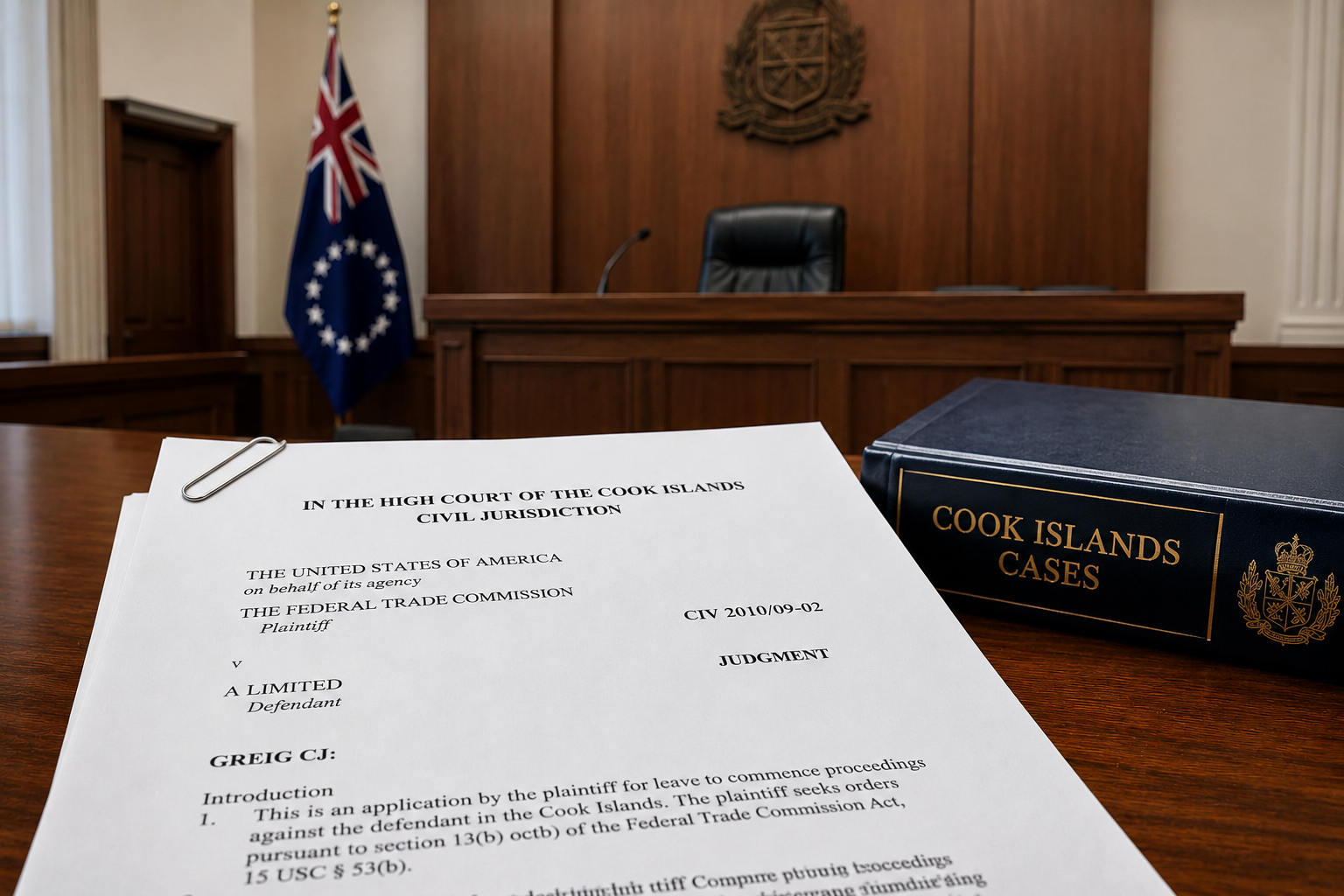
In United States of America on behalf of its agency the Federal Trade Commission v A Limited, the Cook Islands High Court considered whether the FTC’s claim should be allowed to proceed. The Court struck out the action. Greig CJ held that the proceedings amounted to an attempt to enforce, directly or indirectly, a foreign penal, revenue, or public law. The Court found that the FTC Act was regulatory in nature, that the relief sought had at least a penal character, and that the claim was an assertion of foreign sovereign enforcement power which should not be enforced in the Cook Islands.
That is the part of Anderson that too many commentators ignore.
The United States court could deal with the Andersons because they were before it. But the Cook Islands trustee was not an administrative arm of the United States court, far from it. The trustee was subject to Cook Islands law, Cook Islands fiduciary obligations, and the supervisory jurisdiction of the Cook Islands courts.
That is not defiance. That is the rule of law.
Every serious jurisdiction must know where its legal responsibilities begin and where foreign sovereign power ends. The Cook Islands courts did exactly that.
Why this matters
The Cook Islands is not powerful because it promises magic. It is powerful because it has been tested.
Many jurisdictions have attractive statutes. Many can produce brochures. Many can claim to offer strong protection. But the real question is what happens when a foreign creditor, regulator, or court order comes knocking.
In the Cook Islands, we know the answer because it has happened.
The courts have had to consider difficult cases. Trustees have had to make difficult decisions. The jurisdiction has had to stand up under pressure. That is where reputation is earned.
This is why case law matters.
Legislation can be copied. Marketing language can be copied. Even trust deeds can be copied. But a jurisdiction’s judicial history cannot be manufactured overnight.
The Cook Islands has something many competing jurisdictions do not have: a body of hard-won precedent. That precedent shows that the Cook Islands courts will not simply rubber-stamp foreign enforcement efforts. It shows that foreign creditors must proceed according to Cook Islands law. It shows that the jurisdiction takes seriously both the integrity of trust structures and the limits of foreign public-law enforcement.
That is not an accident. It is one of the reasons the Cook Islands remains the pre-eminent jurisdiction for serious international trust planning.
The myth of the failed trust
To say “Anderson proves Cook Islands trusts do not work” is not merely simplistic. It is wrong.
A more accurate statement is this:
Anderson proves that bad facts, excessive settlor control, and poor structural discipline can create serious personal risk for a settlor who remains within the reach of a foreign court.
That is a very different proposition. It is also a useful one.
The trust industry learned from Anderson. Modern planning places far greater emphasis on independent trusteeship, carefully drafted protector powers, avoiding settlor control, asset situs, solvency, timing, and compliance. Those are not cosmetic improvements. They are central to the integrity of the structure.
The point is not to hide from courts. The point is to ensure that a trust is what it says it is: a genuine transfer of legal ownership to a trustee, governed by the law of the jurisdiction chosen by the settlor, administered according to fiduciary principles, and not casually undone because a foreign court or creditor would prefer a different result.
The Cook Islands does not need mythology
One of the mistakes made in this industry is the temptation to overstate. We should resist that.
The Cook Islands does not need to be described as bulletproof. No serious jurisdiction should want that label. It attracts the wrong clients, encourages the wrong commentary, and invites the wrong kind of scrutiny.
The Cook Islands is not a place for evasion. It is a highly regulated jurisdiction with a robust anti-money laundering regime, professional trustees, and a legal system grounded in common-law principles. Its strength lies not in secrecy, but in legal certainty.
That is the message that needs to be understood.
The Cook Islands protects properly established and properly administered international trusts because its law says it should. Its courts have shown that they will apply that law. That is not mythology. That is the record.
A small nation that continues to fight above its weight
The Cook Islands has always had to fight above its weight.
We are a small nation in the middle of the South Pacific. But small does not mean unsophisticated. Small does not mean weak. And small certainly does not mean that our courts should surrender their jurisdiction whenever a larger country seeks to impose its will.
The strength of the Cook Islands has never been simply that it was early to international trust planning. Its strength has been that, when tested, it has relied on law rather than noise.
That is why the Anderson case should be revisited. Not because the facts were attractive. They were not. Not because the Andersons were ideal examples of trust planning. They were not.
But because the case demonstrates something important: a Cook Islands trust must be properly structured, and when it is challenged in the Cook Islands, Cook Islands law matters.
That is the true lesson of Anderson.
For those who wish to criticise the Cook Islands, at least criticise it accurately. For those who wish to understand it, look beyond the headlines. And for those who wish to plan seriously, remember the simple rule that Anderson teaches better than almost any other case:
If you want the benefit of a Cook Islands trust, it must be a Cook Islands trust in substance, not merely in name. The record is strong enough.